
CryoTherapeutics in 2025: A Year Defined by Momentum, Collaboration, and Clinical Progress
Progress is built step by step, through careful clinical work, rigorous discussions, and sustained collaboration across disciplines. For us, 2025 was one of those years where many of those steps came together.
Across clinical research, international scientific forums, new partnerships, and disciplined execution, we advanced our coronary cryotherapy program and continued to deepen the foundation for our next phase of development.
A Year Shaped by Clinical Data and Global Engagement
Early in the year, we shared results from the POLARSTAR First-in-Human study, evaluating the safety and feasibility of intra coronary cryotherapy in patients with high-risk coronary plaques. The study reported:
• Safety First: No device-related complications were observed at 90 days.
• Plaque Stabilization: Serial CCTA imaging at 9 months showed a trend towards reduction in plaque burden and necrotic core volume.
• Physiology Preservation: Trans-lesional FFRCT remained stable over follow-up, confirming preservation of coronary flow dynamics.
The study represents a key milestone in developing localized, minimally invasive treatments for vulnerable coronary plaque – an area of urgent unmet need in cardiology.
Dr. Carlos Collet, MD, PhD, Director of Cardiovascular Imaging, Physiology, and Translational Therapeutics at Cardiovascular Research Foundation (CRF) said: “Over the last decade, we’ve made remarkable progress in detecting high-risk atherosclerosis. The next frontier is identifying which plaques may truly benefit from targeted, local therapy. Cryotherapy is among the most promising approaches—and, with the right patient selection, could emerge as a practical treatment option for vulnerable plaques.”
Over the months, these results traveled the globe: Washington, D.C., Riyadh, Paris, San Francisco, Malta, and Tbilisi. At each major cardiovascular meeting, including CRT, TCT Middle East, EuroPCR, TCT, VPM, and the Georgia MedTechSummit, the data were presented to scientific audiences, contributing to ongoing clinical dialogue around localized, minimally invasive approaches for vulnerable coronary plaques.
Beyond the congress halls, we also participated in innovation and thought-leadership forums such as the Mayo Clinic Innovation Summit and the MedTech Strategist Innovation Summit, where we had the opportunity to share insights, connect with peers, and reflect on broader questions in cardiovascular innovation.
Launching the ICECAP Study
A key development of the year came toward its end, with the announcement of ICECAP, a new clinical study designed to further evaluate coronary cryotherapy using advanced intravascular imaging.
ICECAP brings together three complementary areas of expertise:
• CryoTherapeutics, providing localized coronary cryotherapy
• SpectraWAVE, contributing its HyperVue™ Imaging System integratingDeepOCT™ and Near-Infrared Spectroscopy (NIRS) with AI-assisted analysis
• Cardiovascular Research Foundation (CRF), serving as scientific partner and Core Lab
The ICECAP Study will leverage a multimodality approach that combines Near-Infrared Spectroscopy(NIRS) and next-generation Optical Coherence Tomography (OCT) imaging at the time of the procedure and at nine-month follow-up, in addition to Coronary CTAngiography (CCTA). This multimodal imaging approach will provide unique insights into lesion assessment, and the biological effects of localized cryotherapy over time, including assessment of fibrous-cap thickness and lipidic burden as markers of treatment effect. ICECAP will also incorporateAI-assisted analysis to standardize the detection of high-risk plaque features and measure change over time.
“Starting the ICECAP study with SpectraWAVE’s HyperVue Imaging System will allow us to leverage their novel combination DeepOCT and NIRS assessment to evaluate the efficacy of our cryotherapy for non-obstructive high-risk plaques, alongside planned CCTA assessments,” said Danny Detiège, VP Clinical Affairs of CryoTherapeutics. “This will be an important step in the development of our unique treatment approach to stabilize these high-risk plaques, preventing major adverse events.”
A Team Built for Execution
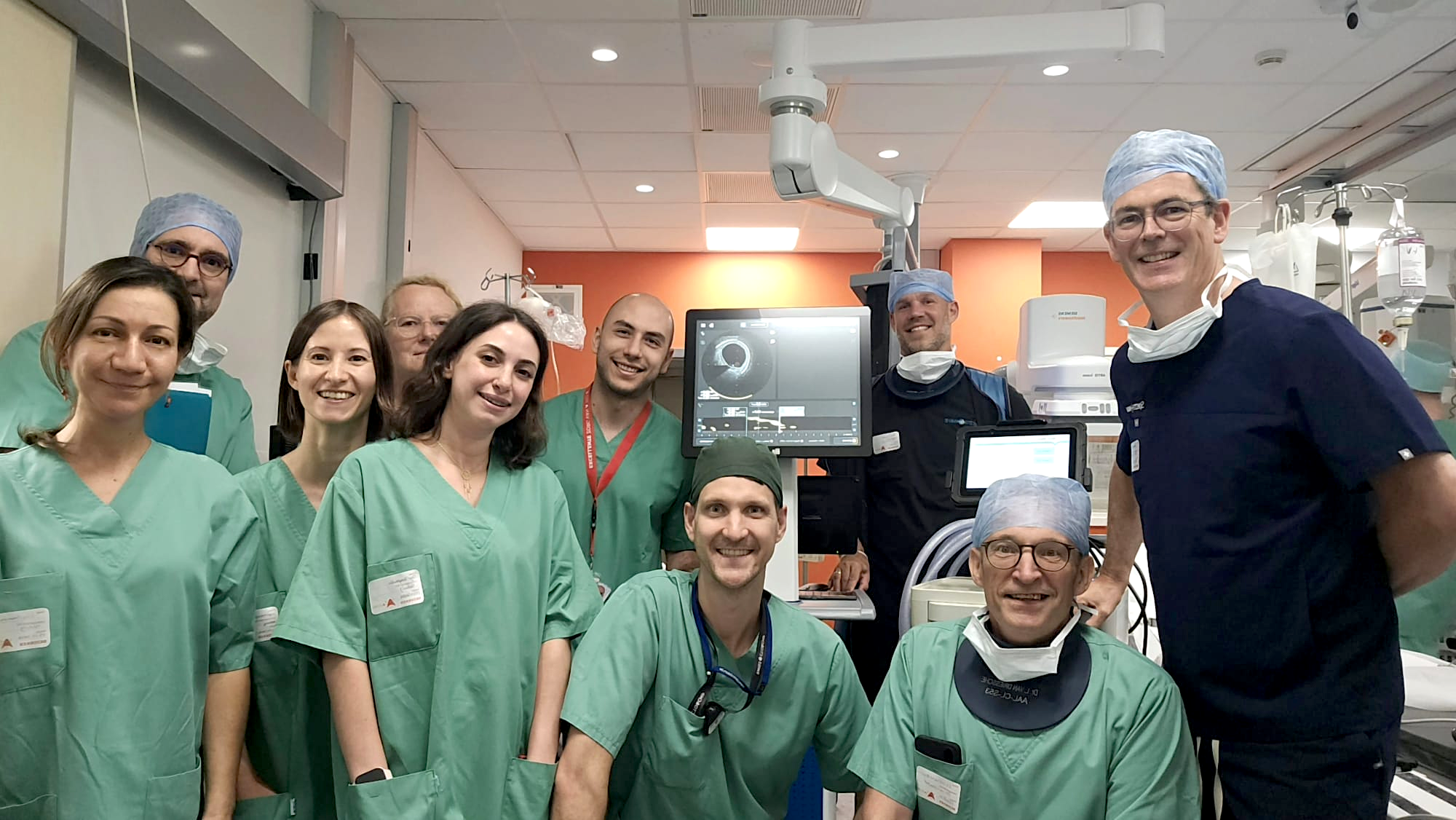
Our momentum was powered by a tightly coordinated, multidisciplinary team spanning clinical, engineering, operations, and research functions. We’ve operated with a strong focus on continuity, precision, and shared responsibility, aligning clinical insights, technical decisions, and research priorities to move thoughtfully without compromising scientific rigor.
This collaborative approach has been key to designing complex clinical studies, working effectively with investigators, and advancing a novel therapeutic approach in a highly regulated environment.
Reflecting on the year, Dr. John Yianni, CEO of CryoTherapeutics, commented: “We are carving a new path in cardiology, driven by curiosity, collaboration, rigorous science, and clinical need. Each study, each insight, brings us closer to understanding and addressing high-risk coronary plaques in ways that have been out of reach until now. Our goal is not just to advance treatment, but to transform the future of heart care for patients worldwide.”
Looking Ahead
2025 set the stage for a new frontier in cardiology. With each study, each collaboration, and each careful observation, we are helping redefine how high-risk coronary plaques are understood and approached.
In the year ahead, ICECAP will push these boundaries further, combining innovative therapy, advanced imaging, and rigorous investigation, to illuminate possibilities that were previously out of reach. The work is ambitious, the questions are complex, and the potential to transform care is real. One year at a time, step by step, we are shaping the future of coronary treatment.